|
|
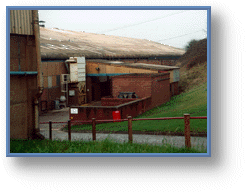
Hanson Brick’s Heather works in Leicestershire uses extrusion, the Peterson process* and also hand made production to make a total of up to 620,000 bricks per week. Five different types of brick are produced in volume using a mixture of up to three types of clay, one from the local quarry and two shipped in from another nearby Hanson site. All are dried, then fired in the gas fired tunnel kiln, but each type of brick requires a different temperature/time firing profile and the fairly short runs needed to be responsive to customer demand mean frequent profile changes. The kiln was fitted with a hybrid control system comprising some Leisenberg computer controllers and some quite old Eurotherm controllers. In late 97, a combination of future maintenance issues, a desire for improved performance and management information and the need to extend the control system to cover the drying as well as the firing process, led Hanson Brick Process Development Manager David Tinsley to plan an upgrade to the controls. The tunnel kiln
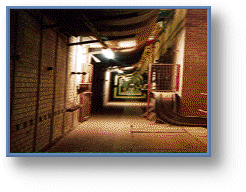
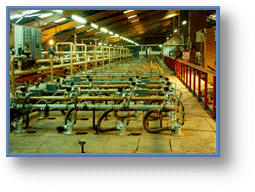
The 100m long, gas fired tunnel kiln at Heather works has a capacity of 51 cars. Of these, 1 car is in the kiln vestibule and 15 cars are in the preheat section which is divided into the two zones. The main firing zone comprises a 2 car length high velocity burner heating zone plus a 12 car length pulsed burner heating zone, all controlled by 28 heating zones, 2 per car. The remaining cars are all the 5 zone cooling section where heat is recovered for the kiln pre-heat section by reverse air flow. Further heat from the cooling section is recovered to provide part of the heat needed for the dryers. Heating is controlled by banks of pulse burners, four abreast across the width of the kiln to give good heat distribution. Pulse burners were chosen because pulsing the flame causes turbulence which improves air circulation and therefore temperature distribution in the kiln. Most of the zones in the kiln are above the safe ignition temperature for gas of 750·C, but the first two zones are fitted with spark ignited burners to ensure safe ignition in the lower temperatures of the pre-heat section. Push time* is typically a few minutes under one hour, resulting in a little over two days to fire a given car. As well as overcoming the Y2k problems with the old system, David Tinsley was keen to achieve a far higher degree of automation when the control system was replaced. Automatic uploading of the setpoints for the controllers from recipes held by the control system was a key requirement, as was automatic logging of all temperatures for analysis and QA records. Temperature readings of the old system were not logged automatically, operators recorded them manually when required. Trend data was also not available. A new control system
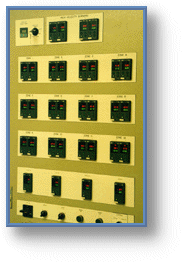
3 companies were asked to tender for the work, which included a stringent requirement to install and commission the new system in the two week annual shut down in June. After analysis, the offer from FGH Controls was accepted. FGH proposed to use 28 of their Series 2000 auto-tuning temperature controllers (see photo) one to each zone, supervised and controlled by a PC based software package configured specially for Hanson’s requirements. The Series 2000 controller includes some unique features making it especially suitable for kiln control. These include a facility to instruct the controller via an external relay contact to turn off the gas supply during a push and a low temperature gas cut off for ignition safety that can be overridden under software control for start up. Most powerful is a facility whereby the controller responds to the change in temperature resulting from a new, colder (or hotter) car entering the zone by temporarily changing its set point to the actual temperature of the zone, then ramping back to the original setpoint at a preset rate under full control. See fig 1. This overcomes the problem that conventional controllers ‘over-react’ to temperature changes immediately after a push, forcing the control to 100% output. Total zone control is now achieved at all times, giving improved fired quality from the kiln. The 28 kiln zone controllers and some auxiliary controllers all communicate with a PC running FGH’s proprietary KilnManager software in a special configuration designed for Hanson Brick. KilnManager provides a number of powerful tools for the operators and supervisors to use. These include storing firing ‘recipes’ for each different brick product and automatic setting the kiln profile for the product being made. The system also keeps track of kiln cars as they progress through the kiln and automatically adjusts the kiln profile to take account of varying push rates and the transitions between different products on adjacent cars. In addition, a suite of charts display graphically, any or all parts of the kiln and each individual car, see photos. To zoom in for more detail, operators have only to draw a box around the area of interest using the mouse. A very useful power display allows monitoring of energy levels applied to individual zones for diagnostic purposes. E.g. if A zones are working extra hard it may indicate that the seals are not performing between the kiln cars. A particular strength of the system is that every controller remains fully independent of the PC, uploading data to the PC regularly, but only taking instructions by exception when changes are needed to the setpoint. This makes the system very robust: the single loop integrity means that any item can be out of service without affecting any other and while the PC functions are very helpful, the system can function without it using manual updates to the setpoints at the time of each push.
The graphical interface makes for easy control of the kiln by the operators. Typically, the temperature profile of the kiln is displayed for normal monitoring operations, and from there, hot buttons link out to other screens, for example, an alternative deviation display that highlights any problems with the temperature profile. From any display, problems are signalled by pop-up on-screen annunciators and alarm messages. These are presented in plain English allowing faster reactions than if codes have to be interpreted. Using the multi-tasking capabilities of Windows 95 to the full, KilnManager is also logging data from every controller at pre-set intervals. It also records data from a number of other sensors linked to the PC by an FGH Integrated control unit. The records are held against batch numbers and can be recalled for display, or can be exported into Excel or similar programmes for further analysis. As well as tracking the batch progress, KilnManager records which operator was logged on at any time and provides a Supervisory level that allows extra aspects of the system to be accessed for recipe adjustment, kiln start up from cold etc. Experiences so far Capital approval was granted in February 98, and an order duly placed with FGH. The replacement control panel was delivered, installed and commissioned without serious mishap during the June shutdown. However, this phase of the installation consisted of the Series 2000 controllers and accessories for semi-automatic operation only. The kiln was operated semi-automatically for some weeks, and apart from the missing software, it all worked well. The KilnManager software configuration followed in August and with a little fine tuning on site to suit operator preferences, has been judged a great success. The PC package makes life much easier for the operators and provides management with a lot of information. Unhappily, the PC and Windows 95 did not perform quite so well, there have been a few hardware reliability problems and a memory leakage problem. However, looking on the bright side, these have provided an opportunity to validate the semi-manual control procedures, and have vindicated the original decision to resist the temptation to specify a budget system that was not fully independent of the PC. On balance, David Tinsley is very pleased with the system and feels that FGH has performed well. “FGH has been easy to work with.” He commented, “They have been responsive to our needs, not just when a problem arose, but in tailoring things to suit us - much more flexible than other companies we have worked with in the past.” This view is well supported by the process operators and local maintenance staff who have had comprehensive training courses from FGH to allow them to maintain the system themselves. However, the degree of satisfaction is perhaps best illustrated by the decision to award contracts for similar work at other Hanson owned brick works to FGH in recent weeks. These recent orders bring to 9 the number of Hanson Brick sites that will be fitted with new control systems from FGH. Notes *Peterson process. This process uses a much wetter clay which is forced into moulds to form the brick, unlike the extrusion process used for most production at Heather. *Push time - ‘Push’ refers to pushing the cars one car position along the kiln. ‘Push time’ is the term used to denote the interval between successive pushes. |